
NOR Gate
Overview
- Purpose: The NOR gate performs a combined NOT-OR logical operation on its inputs. The output is HIGH (logical '1') only when all inputs are LOW (logical '0'); if any input is HIGH, the output is LOW.
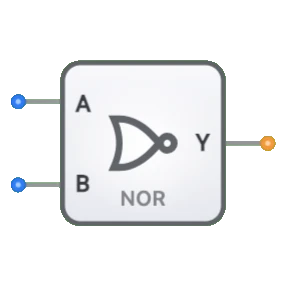
- Symbol: The NOR gate is represented by an OR gate symbol with a small circle (bubble) at the output, indicating inversion.
- DigiSim.io Role: Serves as a universal building block in digital logic circuits, as any digital function can be implemented using only NOR gates.
Functional Description
Logic Behavior
The NOR gate implements the negation of the logical OR operation, producing a HIGH output only when all inputs are LOW.
Truth Table (for a 2-input NOR gate):
| Input A | Input B | Output Y |
|---|---|---|
| 0 | 0 | 1 |
| 0 | 1 | 0 |
| 1 | 0 | 0 |
| 1 | 1 | 0 |
Boolean Expression: Y = !(A + B) (Y equals NOT (A OR B))
Inputs and Outputs
- Inputs: The NOR gate has 2 inputs (A, B).
- Output: A single 1-bit output representing the result of the NOR operation.
Visual Representation in DigiSim.io
The NOR gate is displayed with input pins on the left side and an output pin on the right side. The output includes a small circle (bubble) indicating the inversion function. When connected in a circuit, the component visually indicates the logic state of its pins through color changes on connecting wires.
Educational Value
Key Concepts
- Universal Gate: Demonstrates how a single gate type can implement any digital function.
- Combinational Logic: Shows how a gate's output is determined solely by its current input values.
- Logic Inversion: Illustrates the concept of logical negation combined with OR operation.
- Boolean Algebra: Reinforces understanding of Boolean operations and De Morgan's theorems.
- Digital Circuit Design: Presents a fundamental building block used in various digital systems.
Learning Objectives
- Understand the NOR operation and its truth table representation.
- Learn how NOR gates can be used to implement any digital logic function.
- Recognize the NOR gate's importance in digital circuit design and memory circuits.
- Apply NOR gates to construct other basic gates like NOT, AND, OR, and NAND.
- Comprehend how NOR gates form the foundation of memory cells and latches in digital systems.
Usage Examples/Scenarios
- Logic Implementation: Using only NOR gates to implement more complex functions.
- Memory Cells: Constructing SR latches using cross-coupled NOR gates.
- Integrated Circuits: Implementing digital logic in CMOS technology, where NOR gates are a natural fit.
- Minimal Gate Count Design: Reducing component count by converting circuits to use only NOR gates.
- Basic Logic Functions: Creating NOT gates (by connecting all inputs together) and other fundamental gates.
Technical Notes
- The NOR gate is considered a universal gate because any Boolean function can be implemented using only NOR gates.
- NOR gates are particularly well-suited for CMOS implementation, making them common in modern integrated circuits.
- SR latches built with NOR gates form the foundation of many memory elements in digital systems.
- The propagation delay of NOR gates is generally consistent and predictable, facilitating reliable timing design. Typical 74HC CMOS values are around 7–14 ns at 5 V; 74LS TTL values are around 10–15 ns.
- In DigiSim.io, the NOR gate's behavior simulates real-world digital components with proper handling of input combinations.
Characteristics
- Provides the complement of an OR operation
- Contains a built-in inversion (NOT) function
- Universal gate - any boolean function can be implemented using only NOR gates
- Typically has two or more inputs and one output
- Has a propagation delay from input change to output change
- Less power consumption than using separate OR and NOT gates
Applications
- Construction of other logic gates (NOT, AND, OR, NAND, XOR, XNOR)
- Memory cells (SR latches)
- Digital integrated circuits
- Computer memory systems
- Arithmetic logic units (ALUs)
- Digital signal processing systems
- Universal logic building block in digital designs
Implementation
NOR gates are typically implemented using:
- Transistor-Transistor Logic (TTL)
- Complementary Metal-Oxide-Semiconductor (CMOS) technology
- Common IC packages:
- 7402: Quad 2-input NOR gates
- 7427: Triple 3-input NOR gates
- 7425: Dual 4-input NOR gates
- 7433: Single 8-input NOR gate
Functional Implementation
Other gates can be constructed using NOR gates:
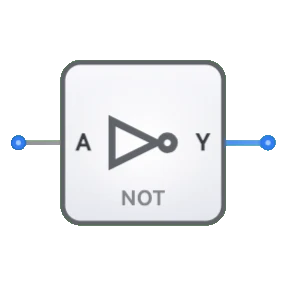
- NOT gate: Connect all inputs of a NOR gate together
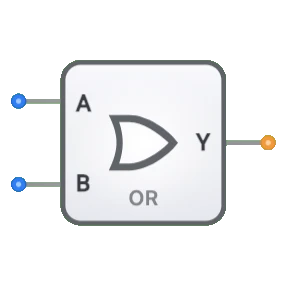
- OR gate: NOR followed by NOT
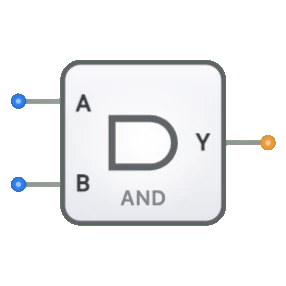
- AND gate: Invert the inputs and use a NOR gate
- NAND gate: Invert the inputs and feed to a NOR gate, then invert the output
Related Components
- OR Gate: Produces HIGH output when any input is HIGH
- NOT Gate: Inverts the input signal
- NAND Gate: Another universal gate with similar capabilities